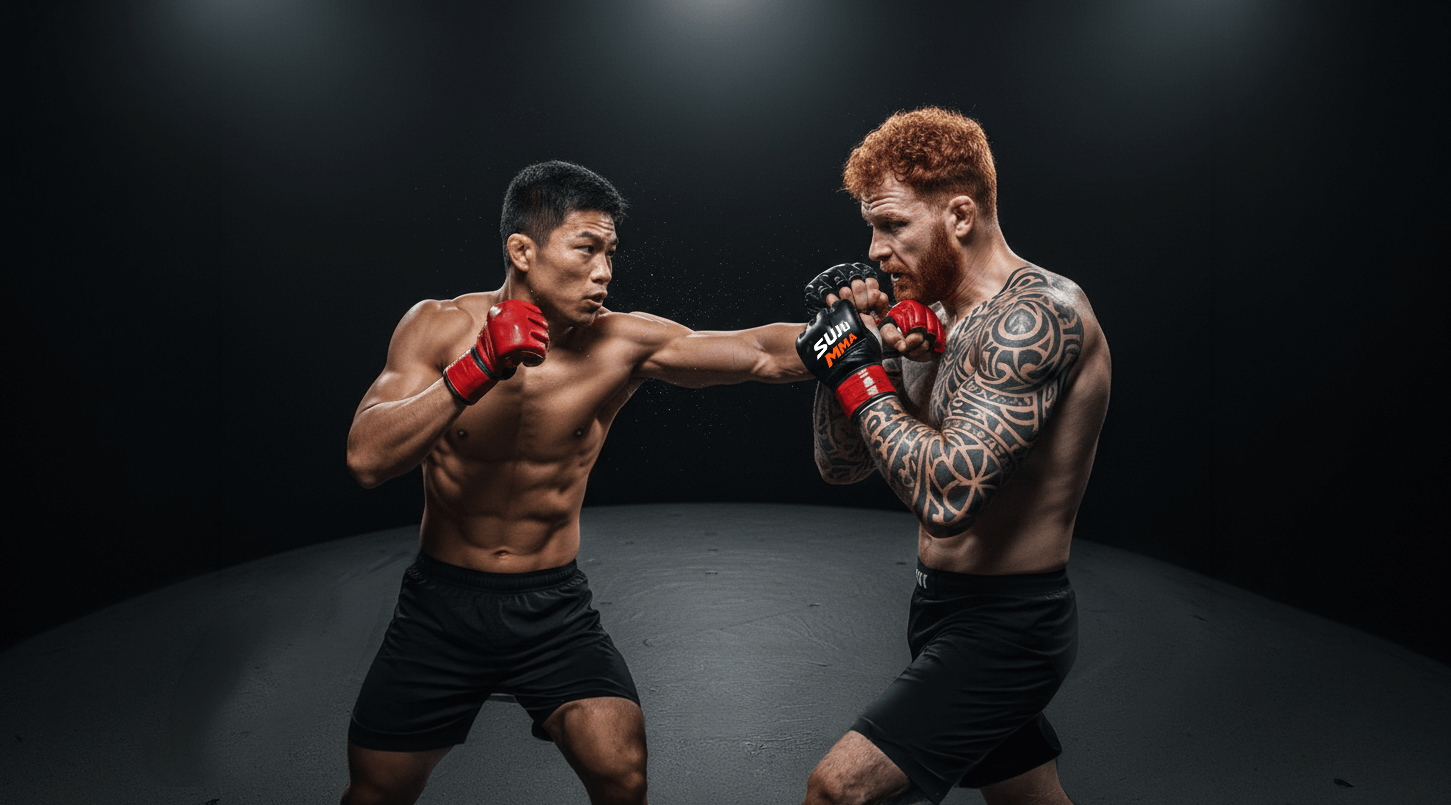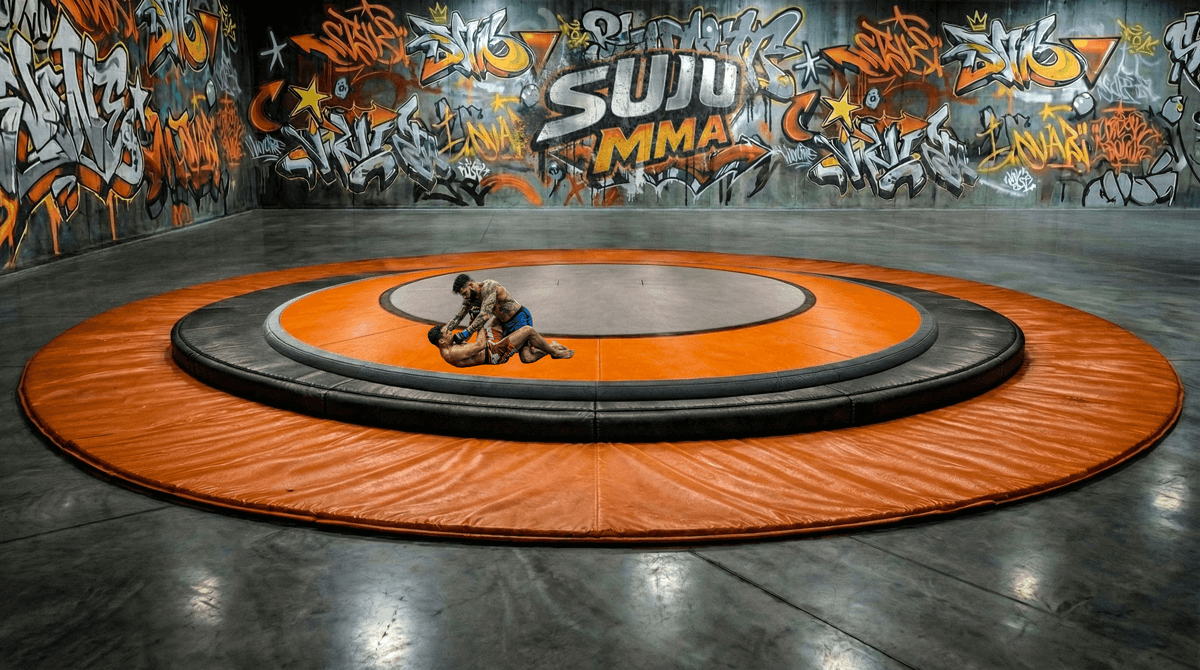
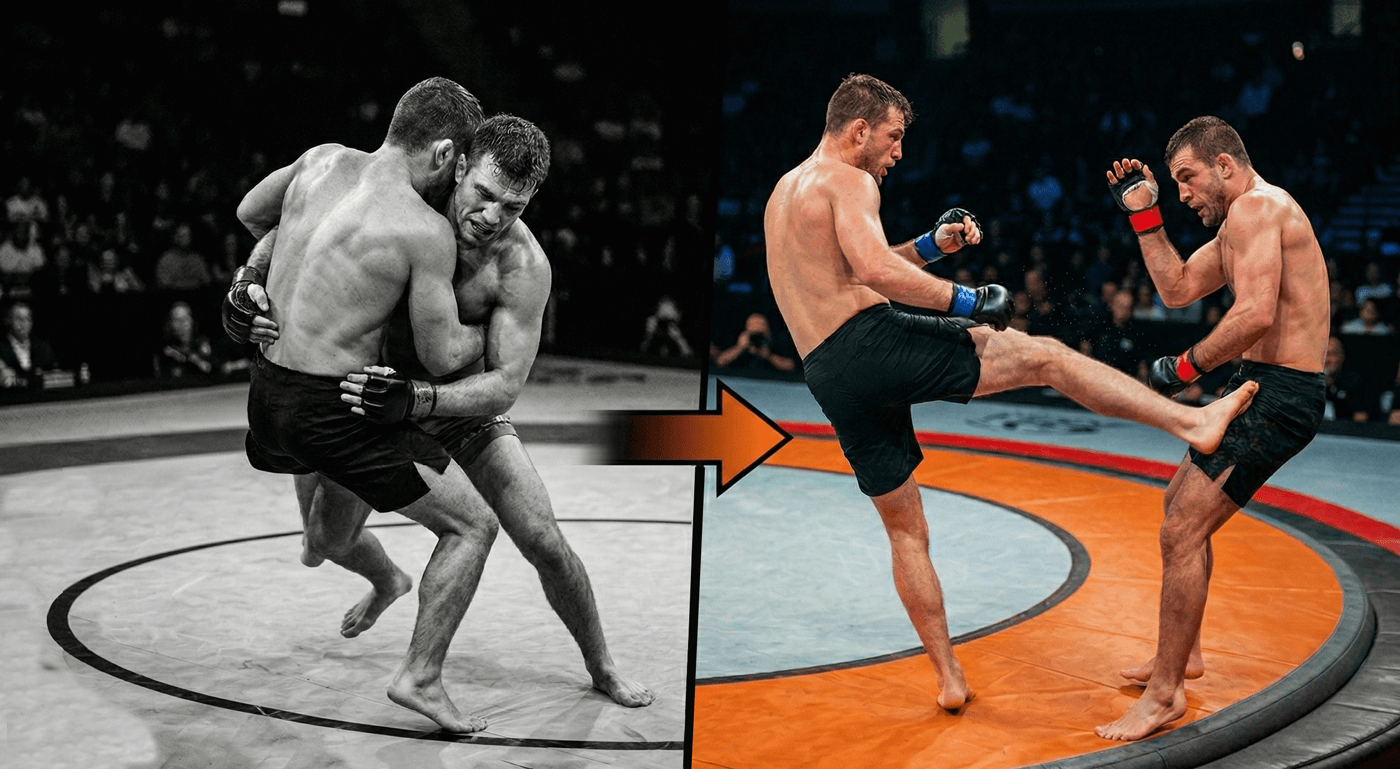
This guide translates the core SUJU scoring system into concepts familiar to MMA, Wrestling, and other martial arts professionals, focusing on the critical loop: Center Control → Edge Pressure → Finish. Because SUJU shifts dynamically between a grappling-heavy center phase and a striking-heavy outer phase, referees and coaches must master the criteria for scoring and the shift between the two combat phases.
SUJU Scoring Table: The Points System
| Scoring Event (The “Move”) | Points | When It Counts | MMA/Wrestling Context |
| Center-Phase Takedown | 1 | Before the first Center Ring-Out occurs. | Opening Sequence Control: Rewards a clean takedown finish right off the whistle, winning the initial positional battle inside the center. |
| Center Ring-Out | 2 | Forcing the opponent out of the inner (Center) Ring. | Positional Break/Reset: Winning the initial pushes and scrambles to exit the inner zone; this is the key to opening the striking phase (“Fight!” call). |
| Outer-Phase Takedown | 3 | After the first Center Ring-Out (“Fight!” state), anywhere in the competition area (or The Mound™). | High-Stakes Finish: Rewards a takedown executed under boundary pressure and active striking threat. |
| Platform Ring-Out | 5 | Forcing the opponent off the entire competition area (the outer ring boundary). | The Decisive Finish: The ultimate reward for ring craft and boundary control (can be round-ending). |
Crucial Notes:
- Combined Score: If a Takedown and a Center Ring-Out occur simultaneously, award the 3-point score (2 for Ring-Out + 1 for Takedown).
- Stalling/Penalty: Intentionally grounding oneself to avoid a Platform Ring-Out incurs an immediate +2 point penalty against the stalling fighter.
- Strikes: No points are awarded for strikes; however, Knockouts/TKOs are still a victory condition.
Understanding The Two Combat Phases (State Changes)
Referees must manage the distinct tactical shift between the Center Battle (Grappling Focus) and the “Fight” State (Striking/Boundary Focus).
Phase 1: The Face-Off & Center Battle
- Start: Face-off inside the center ring, initiated by the referee’s command, “Go”.
- Objective: Win a 1-point Takedown or achieve a 2-point Center Ring-Out.
- State: Striking is disabled. Focus is on throws, trips, and positional control.
Phase 2: The “Fight” State
- Trigger: The moment a fighter is forced out of the center ring ( Center Ring-Out). The referee calls “Fight!”
- State Change: Striking becomes legal. The risk is now elevated due to strikes and the proximity to the outer boundary.
- Escalation: Any takedown secured during this phase is elevated to 3 points.
The Reset Loop: Following a Platform Ring-Out or a Takedown, the clock is paused. Fighters have 10 seconds to return to the center face-off marks. Once reset, striking is disabled until the next Center Ring-Out.
Standard Rules vs. Rule Variations
Before running a SUJU night, gym owners and coaches must establish which ruleset variation is active, as it can drastically alter how the sport is played.
Standard SUJU Rules:
- Striking a grounded opponent is strictly prohibited in standard rules. This makes standard SUJU heavily focused on standing takedowns, throws, and boundary pressure without the threat of ground-and-pound.
- Grounding Rules:
- One knee may touch momentarily during an active takedown attempt (e.g., a deep shot or a slip), but it must be brief and part of a continuous action. (recommended ~1 second).
- If a second knee or any other body part (hip, butt, back, shoulder) touches the mat, it is considered a takedown.
SUJU Variations (Ground Strikes & Submissions):
- Under varied rulesets, ground striking and submissions may be allowed.
- Coach’s Note: If you are running this variation, outer-phase takedowns become devastatingly powerful. Referees must be highly vigilant to protect grounded fighters, and athletes must prioritize quick stand-ups over standard grappling guard retention.
3 Sequence Examples: Who Scores and Why
Sequence 1: The clean opener (center-phase takedown)
- Face-off in center → Red hits a body lock trip → Blue’s knee/hip hits the surface under control.
- Red scores 1 point (takedown before the first ring-out).
- Red scores 1 point (takedown before the first ring-out).
Sequence 2: Center ring-out triggers the fight state
- Clinch pressure battle → Red drives Blue past the center ring boundary. No takedown occurs during the ring-out.
- Red scores 2 points (center ring-out).
- Ref calls “Fight” and striking becomes legal.
Sequence 3: Post-ring-out takedown (outer-phase takedown)
- Later in the round (after the first ring-out), Blue hits a reactive throw and completes it under control.
- Blue scores 3 points (takedown after the first ring-out).
Common Ref/Coach Edge Cases
Edge Case | Official Call / Rule |
Center Ring-Out + Takedown at the same time | Award a single 3-point score. |
Stall Penalty | Failing to return to the center reset within 10 seconds results in a 2-point penalty. Repeated failure results in losing the round. |
Accidental Slips | If a fighter loses footing without being actively engaged by an opponent, the referee may discretionally pause and restart the action without awarding points. |
Tiebreak / Sudden Death | If a final round ends in a tie, a 60-second sudden-death round is initiated. The round can be won instantly with an Outer-Ring Out with all other rules still applying. |
Setting Up a SUJU Pilot Night at Your Gym
You do not need an official sloped “Mound” to pilot the ruleset. You can easily tape a flat mat to run SUJU effectively.
Minimal Viable Setup:
- Center Ring: Tape a 3 meter or 4 meter diameter circle.
- Outer Ring: Tape a 6 meter or 7 meter diameter boundary.
- Starting Marks: Tape two opposing lines 70cm apart in the direct center for consistent face-offs.
We encourage you to test out different sizing and let us know what works best for you. Right now we are leaning towards a 4 meter diameter center-ring and a 7 meter diameter boundary.
Required Personnel: 1 Referee and 1 Scorekeeper (preferably utilizing a visible whiteboard or digital wrestling scoreboard).
Help Us Make Scoring Bulletproof (Refs + Coaches Wanted)
If you’ve officiated, coached, or competed, your feedback is exactly what SUJU needs right now. We are explicitly focused on clarifying edge cases (ring-outs, resets, takedowns on the line, slips), tightening definitions, and pressure-testing scoring so it’s consistent across judges.