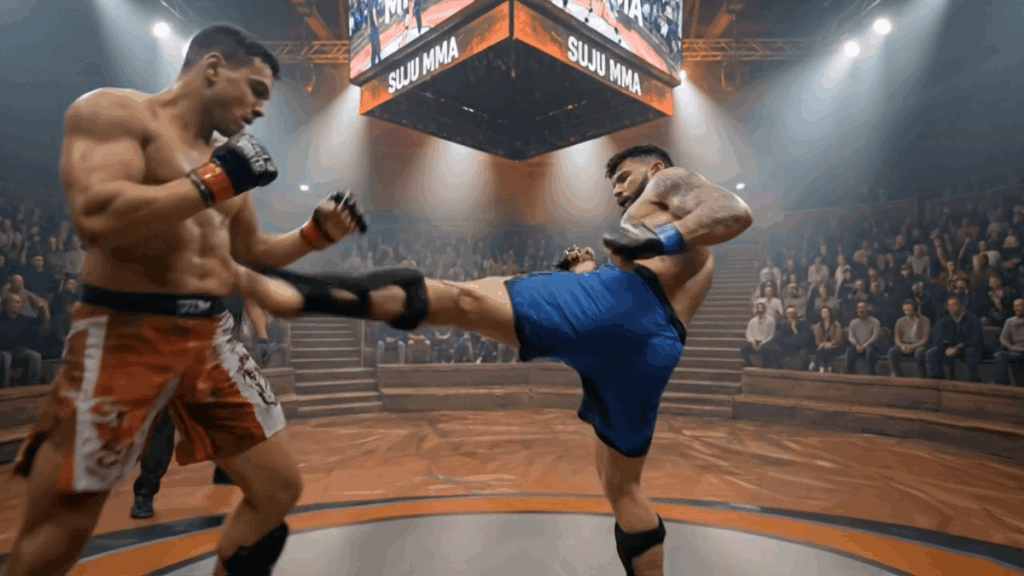
SUJU MMA is a hybrid combat sport built around controlling the center of a circular platform. Rounds begin with a grappling-driven face-off where the first objective is to force a center ring-out or score a takedown, then the fight will shift mid‑round as striking becomes legal after the initial center ring-out or qualifying moment.
For more information about the rules, visit: https://gxv.3f9.myftpupload.com/suju-rules/
To read more about what exactly SUJU MMA is, visit: https://gxv.3f9.myftpupload.com/blog/what-is-suju-mma/
Each round starts with both fighters facing off on the marked lines inside the center ring. The referee initiates action, and fighters begin with stand-up grappling and pushing/pulling exchanges to control the center.
For more information about the rules, visit: https://gxv.3f9.myftpupload.com/suju-rules/
In the standard SUJU MMA ruleset, no strikes are allowed during the initial face-off. Open-hand thrusts (sumo-style) are permitted, along with clinching, stand-up grappling, and throws, until the first center ring-out or a qualifying rule-trigger opens striking.
For more information about the rules, visit: https://gxv.3f9.myftpupload.com/suju-rules/
A Center Ring-Out occurs when one fighter forces the other out of the center ring boundary. It’s a core scoring event and can also trigger the next phase of the fight where striking becomes legal (per the ruleset).
For more information about the rules, visit: https://gxv.3f9.myftpupload.com/suju-rules/
If a takedown didn’t happen during the ring-out, the referee calls “Fight,” and legal striking becomes permitted. This mid-round “state change” is one of SUJU MMA’s signature mechanics.
For more information about the rules, visit: https://gxv.3f9.myftpupload.com/suju-rules/
To read more about what happens after the initial center ring-out, visit: https://gxv.3f9.myftpupload.com/blog/strikes-activate-rule-strategy-shifts/
Yes. After a platform ring-out or takedown event that stops action, the round clock pauses and both fighters reset to the center for a new faceoff within a short referee count. Failure to reset can result in penalties and potentially losing the round.
For more information about the rules, visit: https://gxv.3f9.myftpupload.com/suju-rules/
Standard bouts are typically 3 rounds × 3 minutes. Championship bouts are typically 5 rounds × 3 minutes (unless a pilot variation changes this).
For more information about the rules, visit: https://gxv.3f9.myftpupload.com/suju-rules/
A match can be won by points at the end of the bout, by KO/TKO, or by referee stoppage (depending on event rules and pilot variations). Platform ring-outs can also score heavily and may end rounds/events in certain formats or tournament styles.
For more information about the rules, visit: https://gxv.3f9.myftpupload.com/suju-rules/
In standard SUJU MMA, submissions and chokes are not permitted. However, SUJU publishes pilot variations (e.g., Standing Submission Variation or SUJU Jitsu) that may allow limited submission attempts under specific constraints.
For more information about the rules, visit: https://gxv.3f9.myftpupload.com/suju-rules/
No, In standard SUJU MMA rulesets, ground-and-pound is not permitted. The sport focuses on stand-up grappling, throws, ring-outs, and (once activated) controlled striking while standing.
However, there are rule variations that do allow for ground and pound.
For more information about the rules, visit: https://gxv.3f9.myftpupload.com/suju-rules/
Once striking is activated (e.g., after the first center ring-out, not resulting in a takedown), legal techniques can include punches, elbows (excluding 12–6), knees, and kicks to legal target areas—along with clinching, throws, sweeps, and takedowns (subject to surface safety rules).
For more information about which strikes are legal, visit: https://gxv.3f9.myftpupload.com/suju-rules/#LegalStrikes
Examples of prohibited actions include eye gouging, groin attacks, headbutts, strikes to the back of the head/spine, 12–6 elbows, small joint manipulation, grabbing the mat/slope edge for leverage, and striking a grounded opponent.
For more information about common fouls in SUJU, visit: https://gxv.3f9.myftpupload.com/suju-rules/#Fouls
No. Striking a grounded opponent is prohibited in the SUJU MMA rules posted on the website. (A grounded opponent is defined in the rules as having any body part other than hands or feet on the surface.)
However, there are rule variations that do allow for ground and pound.
For more information about the rules, visit: https://gxv.3f9.myftpupload.com/suju-rules/
Slams may be permitted within safe range on the mat platform, but the rules note safety restrictions (e.g., no pile-driving/spiking). For dirt mound formats, slam allowances may be restricted further for safety.
SUJU uses a point system that rewards ring-outs and takedowns/sweeps. The website and rulebook describe point values for center ring-outs, takedowns (before/after the first, center ring-out), and outer/platform ring-outs (the highest-value event).
SUJU MMA Point System:
To learn more about the SUJU MMA point system, visit: https://gxv.3f9.myftpupload.com/suju-rules/#points
SUJU MMA is designed for a circular platform, called The Mound™, with a flat center ring and a surrounding sloped outer ring. The slope encourages center control and creates an “edge-risk” dynamic that makes ring control a primary strategy.
No. SUJU MMA is designed without ropes or a cage, relying on the platform boundary (and surrounding safety padding or sand perimeter) to define ring-outs and maintain safety.
Suggested SUJU links:
SUJU MMA requires standardized shorts, approved MMA gloves (commonly 4 oz), mouthguards, and groin protection. (Pilot variations like SUJU Jitsu may introduce gi/no‑gi options.)
Headgear and shin guards may be required during initial pilot testing and tournaments.
SUJU Tekken (with Bare Knuckle option) is listed as a variation where the rules largely follow SUJU MMA, but striking is restricted to punches (no kicks, knees, or elbows) and hand-wrapping requirements apply. This is a pilot concept and not necessarily the standard ruleset.
*Bare knuckle events wouldn’t be considered until extensive testing has occured.
Suggested SUJU links:
Go to the Contact form and select “Become a SUJU MMA Fighter.” Share your background, weight class, and training location.
Get started today!
Suggested SUJU links:
Not necessarily. SUJU MMA is designed to attract athletes from many combat sports. For pilot scrimmages, the league can match fighters based on experience and may run controlled test rounds to validate safety and rule balance.
Suggested SUJU links:
Pilot scrimmages are used to test variations of the ruleset and surface. Expect structured rounds, controlled intensity, and feedback sessions so the rules and scoring can be refined before official competitions.
Visit the Advisory Committee page and hit “Join Now,” or use the Contact form and select “Join the Rules & Regulatory Advisory Committee.”
Share your credentials and how you’d like to contribute (officiating, safety, scoring, technique review, etc.).
Suggested SUJU links:
SUJU MMA is recruiting experienced martial artists and combat-sports professionals who want to help shape a sport at inception.
This includes coaches, fighters, referees, judges, and safety-minded practitioners from striking and grappling backgrounds.
Suggested SUJU links:
Use the Contact form and select “Become a Partner.” Include your gym name, location, coaching staff bios, and whether you want to host a ruleset test session or help recruit fighters.
To get this sport off the ground, we need gyms all across the nation to at least give SUJU a try.
Early adopters will get the added exposure to their gym’s brand.
Suggested SUJU links:
Use the Contact form and select “Become a Sponsor,” “Become a Volunteer,” or “Become a Partner.”
Share what you can offer (venue access, equipment, production, brand sponsorship, etc.) and your preferred way to connect.
Suggested SUJU links:
Muay Thai is a striking sport (punches, kicks, knees, elbows) with clinch work and a ring boundary, but it’s not built around takedown/ring-out scoring. SUJU MMA adds a wrestling/throw-first opening phase and makes ring control (center vs edge) central to both scoring and risk management.
Learn the rules below and share ways you have integrated your own techniques!
Suggested SUJU links:
Sumo is primarily a ring-out sport with no striking, where stepping out or touching the ground with a non-foot body part typically loses the bout.
SUJU MMA borrows the ring-control objective but adds a mid‑round phase shift where striking can become legal and points accumulate over timed rounds.
Suggested SUJU links:
Judo focuses on throws, pins, and submissions with no striking; a match can be decided by ippon/waza‑ari and includes strict rules around groundwork and penalties. SUJU MMA starts with stand-up grappling like judo, but then can allow striking after the first center ring-out and the scoring/strategy is heavily influenced by ring position and ring-outs.
Suggested SUJU links:
Many karate kumite formats score points for clean striking techniques and enforce strict penalties for excessive contact, with limited clinch/throw allowance depending on the ruleset.
SUJU MMA is built for continuous engagement with clinching, throws, ring-outs, and (after activation) full-contact striking under its own foul set.
Suggested SUJU links:
.
Boxing is limited to punches and specific clinch/knockdown rules within a roped ring.
SUJU MMA can allow kicks, knees, elbows, and throws (depending on the fight phase and rules variation), and it uses ring-outs/takedown scoring rather than boxing’s punch-only scoring framework.
Suggested SUJU links:
Bare-knuckle boxing promotions generally restrict strikes to punches (and often limit clinch time), and fights happen inside a ring designed for striking exchanges.
SUJU MMA includes a grappling-driven opening phase and ring-out strategy, and standard SUJU MMA uses MMA gloves (with bare-knuckle being a listed pilot variation under SUJU Tekken).
Suggested SUJU links:
Unified MMA rules (used widely in UFC-style competition) allow submissions, ground-and-pound, and are typically fought in a cage or fenced enclosure.
Standard SUJU MMA changes the fight state mid-round (strikes activate after the first center ring-out), emphasizes ring-outs, and does not permit submissions/chokes or ground strikes in its standard ruleset.
For added variations that include ground strikes and submissions, please review the rules below.
Suggested SUJU links:
Yes. SUJU MMA explicitly prohibits striking a grounded opponent in the published rules. That aligns with the general concept in many combat-sport rule sets of protecting say ‘downed’ fighters, though definitions differ across sports.
For variations that include ground and pound allowance, visit the rules link below.
Suggested SUJU links:
It’s intentionally a hybrid: the ring-control and ring-out pressure is sumo-like, the opening grip-fighting and throws borrow from grappling arts, and the later-phase striking resembles modern MMA, while still keeping its own unique restrictions (like no standard submissions or ground strikes in standard rules – see variations in the ‘variations’ tab within the rules link below).
SUJU was created to showcase all martial arts techniques.
Suggested SUJU links:
The open platform enables ring-outs and makes center control the primary strategic objective. Fighters must manage aggression while staying balanced near the edge. SUJU’s platform concept also emphasizes a slightly sloped perimeter for creating dynamic footing changes.
Just like the natural environment changes in the real world, we do it here on The Mound™.
Suggested SUJU links: